


🏛️Official — Comune Firenze
Loading OpenSourceSports…
Players Must Have Genuine Roots in Their Quartiere
Competitors are expected to be born in or have deep, authentic ties to the neighborhood they represent. Recruiting outsiders—particularly professional fighters with no real connection to the district—is widely condemned as violating the sport's identity as a civic ritual, even when not formally prohibited.
50 minutes (single continuous period — no halftime); No substitutions: players who exit (injury, ejection) are not replaced; Reduced-team play continues if one side has fewer players
Why people argue about this
People often assume that without a halftime and substitutions, matches would be brutal affairs with players exhausted quickly. But in Calcio Storico Fiorentino, the intense focus on maintaining control of the ball and quick passing means teams can still manage for 50 minutes without needing to rest or change up their lineup. The key is in how they adapt strategies within this strict timeframe.
Score a "caccia" (goal) by getting the ball over the opposing team's full-width goal at the end of the piazza; Goals can be scored by carrying, throwing, or kicking the ball over the goal line — any method; Throwing the ball over the goal-line but missing → counted as half-caccia (mezzo caccia) t...
Why people argue about this
People often assume that in Calcio Storico Fiorentino, you can score a goal by throwing the ball over the goalposts from anywhere on the field, which is incorrect. The official rule specifies it must be over the opposing team's full-width goal at the end of the piazza, limiting where and how scoring is possible, leading to misunderstandings about the game's mechanics.
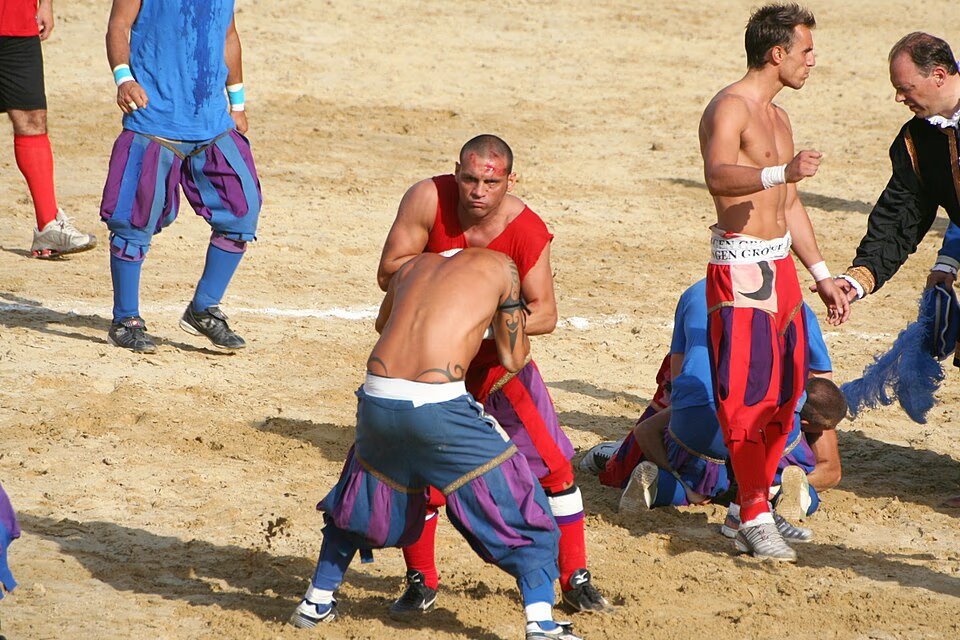
Wrestling (one-on-one only): a player may grapple an opponent who is currently in possession or actively involved with the ball; Punching (one-on-one only, modern rule restriction): no group attacks; modern rules limit head-shots; Body checks + tackles fully legal
Why people argue about this
People often assume that wrestling in Calcio Storico Fiorentino is limited to one-on-one matches, thinking it's a strict restriction on team-based grappling. However, the key fact is that while wrestling (one-on-one only) is permitted for physical contact, this doesn't mean teams can’t use wrestling techniques collectively; they just have to stick to individual wrestling moves when applying them.
No kicks to the head; No striking from behind; No ganging up (multiple players attacking one opponent)
Why people argue about this
People often assume that punching is only disallowed in team games, thinking it's a universal no-no across all Calcio Storico Fiorentino formats, including one-on-one matches where the official verdict clearly states it’s permitted under specific conditions. The confusion arises because they overlook the key fact about the rule being limited to one-on-one scenarios.
Ball: leather "palla" (similar to medieval European football); slightly smaller than modern soccer ball; Player uniform: traditional 16th-century costume in team color (white, blue, red, or green) — long pantaloons + headscarf, no shoes or modern athletic gear; No helmets, no pads — bare-knuckle,...
Why people argue about this
People often assume that mouthguards are a modern addition to traditional Calcio Storico Fiorentino attire, forgetting that they were actually part of the original game's equipment as per historical records. The confusion arises because in this specific adaptation, officials have decided to reintroduce them for safety reasons without altering the core historical practices.
Piazza Santa Croce, Florence — the central piazza is converted to a sand-covered playing field for the annual tournament; Field dimensions: ~80 m × ~40 m; Marked goal lines at each end of the piazza (low netted goals, span the full width)
Why people argue about this
People often assume that Calcio Storico Fiorentino's playing area must be a sandy beach like in volleyball, but actually, it's a specially prepared sand-covered piazza in Florence with marked goal lines and compacted sand surface to ensure fair play on uneven terrain.
27 players per side on the field (one of the largest team formats in any organized sport); Positions: 4 datori indietro (defenders, "back-givers"), 3 datori innanzi (sweepers), 5 sconciatori (midfielders), 15 innanzi/corridori (forwards); Officials: 1 main referee (Giudice Commissario) + 6 line j...
Why people argue about this
People often assume that Calcio Storico Fiorentino's player count includes substitutes, leading to arguments about how many players are actually on the field during a match. The confusion arises because in this historic Florentine sport, like other similar ones, the official verdict specifies 27 active players per side, not including any substitutions allowed under traditional football rules.
50 minutes (single continuous period — no halftime); No substitutions: players who exit (injury, ejection) are not replaced; Reduced-team play continues if one side has fewer players
Why people argue about this
People often assume that substitutions are allowed in some form during Calcio Storico Fiorentino matches simply because it's a continuous play format, but actually, they misunderstand the spirit of the game where no substitutions are permitted to maintain the historical integrity and physical challenge inherent in this ancient sport.
1 point per caccia (goal); −0.5 points per mezzo caccia (missed throw over goal-line) — incentivizes careful ball-handling; Team with most cacce after 50 minutes wins; tie = match goes to extra time or "draw" depending on bracket round
Why people argue about this
People often assume that scoring in Calcio Storico Fiorentino is a binary system where you either get 1 point for a goal or nothing for a missed throw-over, but actually, it's more nuanced: they award 1 point for a caccia (goal) and -0.5 points for a mezzo caccia (missed throw over), which can lead to some strategic confusion in game management.
Ganging up (multiple players attacking one): ejection from match; Strikes from behind, head-kicks, hitting downed opponents: ejection from match; Unsportsmanlike conduct / fighting outside ball-play: ejection
Why people argue about this
People often assume that the immediate ejection for ganging up is just about physical contact, forgetting that it also covers unsportsmanlike tactics like taunting or deliberately interfering with an opponent's ability to play. The confusion arises because they overlook how this rule extends beyond direct physical aggression to include any behavior deemed unfair by the referees.
Calcio Storico Fiorentino is one of the most physically dangerous traditional sports actively played — injuries during the annual tournament typically include broken noses, dental damage, fractures, dislocations, and concussions. Pre-event medical clearance required.
Why people argue about this
People often assume that the requirement for pre-event medical clearance is only about checking if players have insurance, forgetting that it's crucial for ensuring all participants are in good health physically before engaging in such a high-impact sport like Calcio Storico Fiorentino, where injuries from broken noses to concussions are common.