

🏛️Official — NCAA
Loading OpenSourceSports…
Individual Sports
1 players
indoor
bowling ball, bowling pin, lane
10 essential rules
NCAA Women's Bowling is a championship-only NCAA sport contested by NCAA Division I, II, and III institutions in the winter semester. Unlike most NCAA sports, NCAA Women's Bowling is a single national championship covering all three divisions (no separate D1/D2/D3 brackets). The NCAA Women's Bowl...
Traditional team format: each of the 5 bowlers bowls 10 frames; team total = sum of individual scores; 5 frames per game; Baker format: 5 bowlers rotate through frames — bowler 1 bowls frames 1+6, bowler 2 bowls frames 2+7, etc.; team total per game; tactical depth comes from bowler order; Match ...
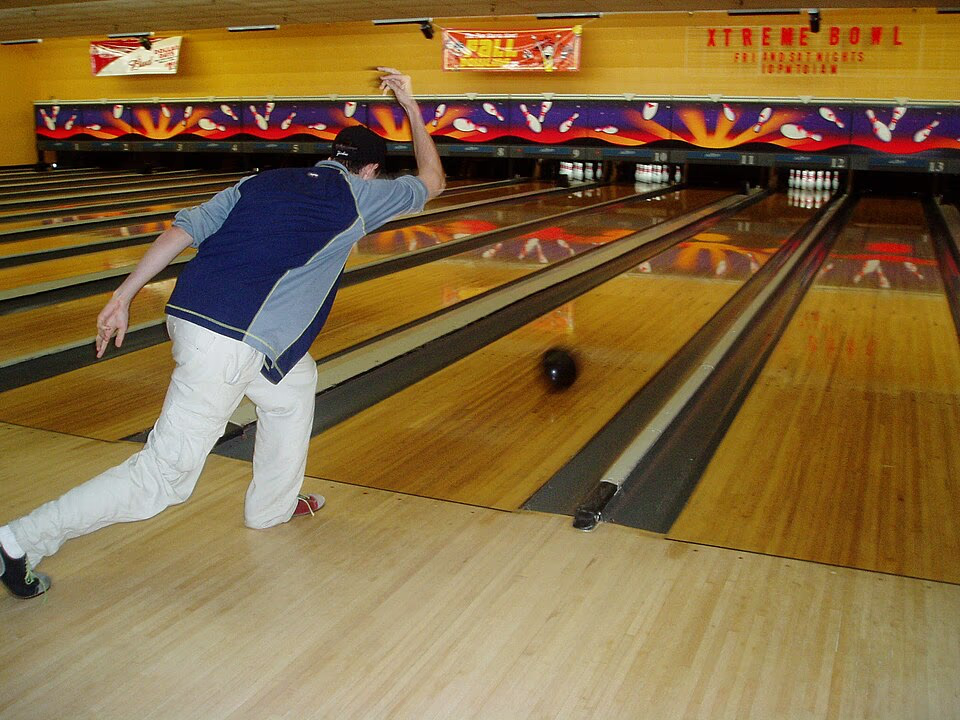
10 frames per game; first 9 frames: bowler gets 2 balls per frame (or until all pins down); 10th frame: bonus rolls if a strike or spare is rolled (up to 3 balls in the 10th); Bowler must release the ball before crossing the foul line (foul = 0 pins for that ball)
NCAA Women's Bowling uses a published list of oil patterns rotated through the championship. Common NCAA patterns include "U.S.
Bowlers alternate from the lane pair (each match is contested on a lane pair, with bowlers crossing back and forth between the two lanes for each frame).
Bowling ball: per USBC specifications — max diameter 8.595", max weight 16 lb (per ball), drilled to fit individual bowler; Each bowler may register up to 6 balls per tournament; balls must pass USBC inspection (oil absorption, hardness, surface); Bowling shoes: required, with the sliding shoe (l...
NCAA Women's Bowling uses a published list of oil patterns rotated through the championship. Common NCAA patterns include "U.S.
Roster: 5 bowlers per team active for each match (additional bowlers may be substituted in/out depending on format); Substitutions: permitted between games per the published rule book; Officials: tournament director, head official, lane officials, score keepers
Bowlers alternate from the lane pair (each match is contested on a lane pair, with bowlers crossing back and forth between the two lanes for each frame).
Strike (X): all 10 pins down on first ball; score = 10 + the next 2 balls' pin totals; Spare (/): all 10 pins down across 2 balls; score = 10 + the next 1 ball's pin total; Open frame: pins remaining after 2 balls; score = pin total
Foul: any part of the body crosses the foul line during release — 0 pins counted for that ball; pin reset; Lofting: throwing the ball more than a defined distance past the foul line in the air — at the official's discretion may be a foul; Illegal ball: ball not on USBC-approved list, ball failing...
Yield lane courtesy to the bowler who stepped up first
When a bowler on an adjacent lane steps onto the approach first, you wait until they have delivered their ball and stepped off before taking your own approach. This is the single most foundational etiquette norm in all of bowling, observed at every competitive level including NCAA.
In NCAA match play where multiple pairs bowl simultaneously, awareness of adjacent lanes is constant. The bowler already set on the approach always has right of way.
Never handle or pick up another bowler's ball
A bowling ball is drilled to an individual's exact hand span, finger sizes, and grip style. Picking up, throwing, or even closely handling another competitor's ball without explicit permission is a serious violation of respect. At the NCAA level, balls represent significant personal investment.
Maintain silence and stillness when a bowler is on the approach
Do not speak to, walk near, or create distractions for any bowler who is addressing the lane or mid-delivery. This extends to teammates celebrating a previous shot — hold it until the neighboring bowler has finished. Disrupting concentration on the approach is considered a serious breach.
In NCAA team competition (Baker format, etc.) where sideline energy is high, knowing when to pause a celebration out of respect for an adjacent bowler is a mark of competitive maturity.
Ready to dive deeper?