


🏛️Official — NCAA
Loading OpenSourceSports…
Team Sports
5 players
indoor
basketball, backboard, rim
10 essential rules
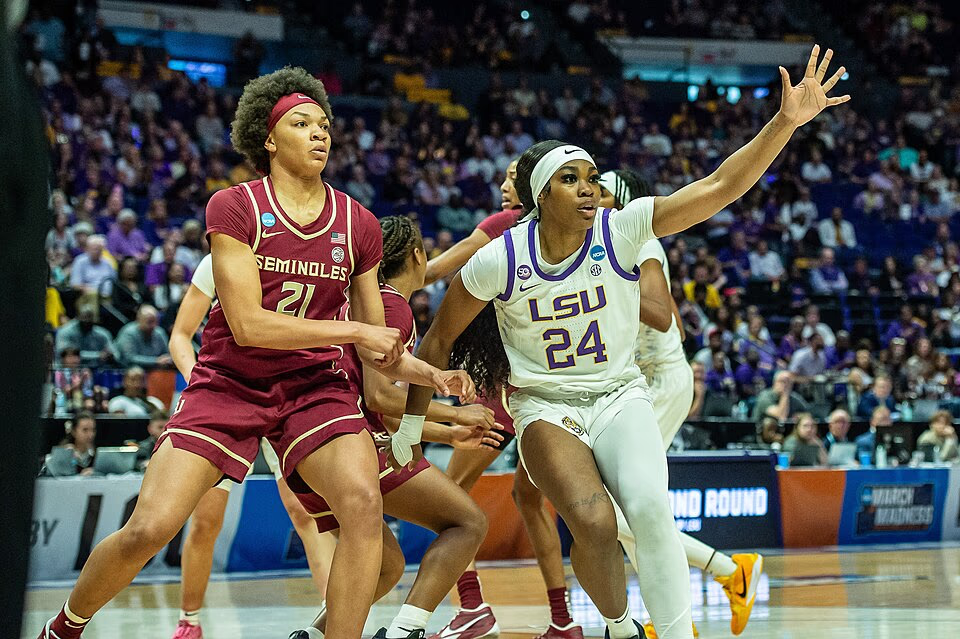
NCAA Women's Basketball is the collegiate variant of women's basketball played under the rules of the National Collegiate Athletic Association. NCAA women's basketball differs from NCAA men's basketball in several key ways: four 10-minute quarters (vs. two 20-minute halves in M's, since 2015-16),...
Basket: 18-inch ring at 10 feet (3.05 m) height; Backboard: 6 feet wide × 3.5 feet high, rectangular; Net: white cord, 15-18 inches
Flagrant 1: excessive contact not directed at head/neck — 2 FT + possession; remains in game; Flagrant 2: dangerous or intentional contact, head/neck contact — 2 FT + possession + ejection; Replay review confirms flagrant fouls
Four 10-minute quarters (adopted 2015-16; distinguishes NCAA W's from NCAA M's halves); 2-minute breaks between Q1/Q2 and Q3/Q4; 15-minute halftime; 5-minute overtime periods until a winner is determined
Closely-guarded 5-second rule (defender within 6 feet); Backcourt 10-second rule; 3-second lane violation
Traveling, double dribble, carrying, goaltending, basket interference; 5-second closely-guarded, 10-second backcourt, 3-second lane
5 personal fouls = foul out. Common personal fouls: blocking, charging, pushing, holding, hand-checking, illegal screen.
Same uniform standards as the men's variant: team uniform with school logo and unique numbers, athletic shoes for indoor surface. Mouthguards recommended; jewelry prohibited except per religious-exemption framework.
Same uniform standards as the men's variant: team uniform with school logo and unique numbers, athletic shoes for indoor surface. Mouthguards recommended; jewelry prohibited except per religious-exemption framework.
Bench, scorer's table, and 28-foot coach's box layout match the men's specification.
Unlimited substitutions at dead-ball stoppages on the scorer's signal; substituted players may re-enter.
Call off the press when winning by a large margin late
Continuing to run a full-court press against an overmatched opponent in the final minutes of a blowout is widely condemned as disrespectful. Coaches who maintain traps and presses up 25+ points late in games draw criticism from peers, media, and fans for prioritizing stats over sportsmanship.
More scrutinized at NCAA level where lopsided conference matchups occur regularly; coaches have been publicly called out for violating this.
Help a fallen opponent to her feet
Reaching down to help an opposing player up after a collision, hard foul, or fall is a deeply ingrained sign of respect in women's basketball. Failing to offer a hand — especially after a foul you committed — is noticed and considered disrespectful.
Commentators and coaches frequently cite this as a marker of the culture and character of women's basketball specifically.
Participate in the postgame handshake line with genuine respect
After games, players line up to shake hands with opponents. Going through the motions coldly, refusing to make eye contact, or skipping the line entirely is considered a serious breach of sportsmanship. The expectation is genuine acknowledgment, not a perfunctory gesture.
Ready to dive deeper?
Opponents injured on the floor are met with immediate stillness and silence from both benches
When a player is injured and down, all competitive posturing stops. Players from both teams take a knee, coaches stand quietly, and play resumes only after the injured player is attended to and the situation is resolved. Continuing to warm up, talk loudly, or act indifferent is considered deeply disrespectful.