


🏛️Official — NCAA
Loading OpenSourceSports…
Team Sports
5 players
indoor
basketball, backboard, rim
10 essential rules
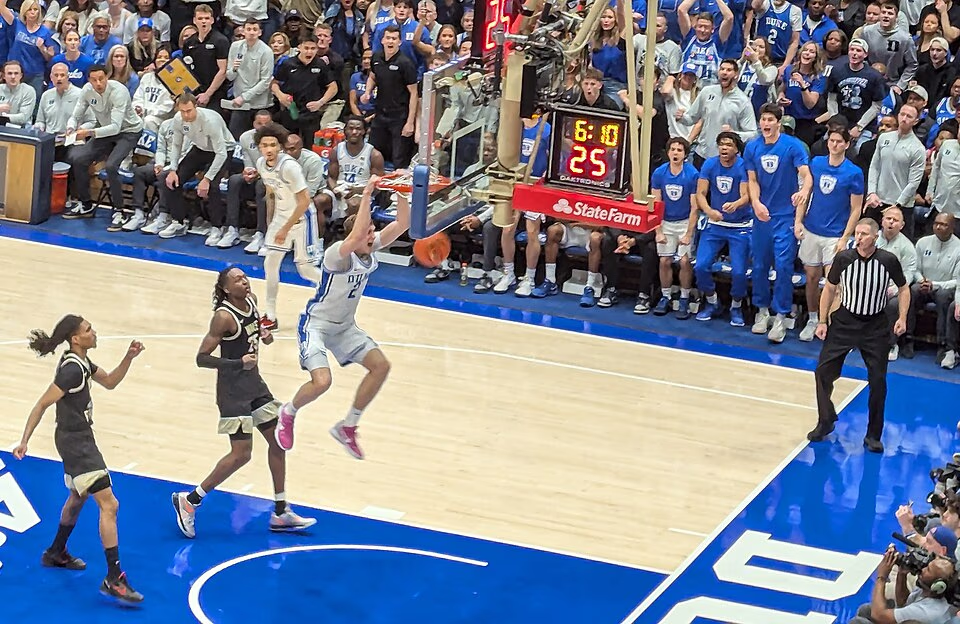
NCAA Men's Basketball is the collegiate variant of basketball played under the rules of the National Collegiate Athletic Association. NCAA men's basketball differs meaningfully from FIBA (international) and NBA (professional) rules — most notably in the use of two 20-minute halves rather than qua...
Team bench seating along one sideline with the scoring/timing table opposite. Coach's box defined for the head coach with a 28-foot designated coaching area extending from the baseline.
1-and-1 bonus: starts at the team's 7th team foul per half — the offended team shoots one free throw and, if successful, a second; Double bonus: starts at the team's 10th team foul per half — the offended team shoots two free throws automatically
NCAA men's basketball uses a coaches'-challenge framework allowing a head coach to request video review of designated reviewable situations (out-of-bounds calls in the last 2 minutes, basket interf...
NCAA medical observers and team medical staff have authority to remove a player from the game for actual or suspected concussion. Removed players are subject to a graduated return-to-play assessment before being cleared for subsequent competition.
Rectangular court, 94 feet long × 50 feet wide (28.65 m × 15.24 m); Painted lane (key): 12 feet wide × 19 feet from baseline to free-throw line; Three-point arc: 22 feet 1.75 inches from the center of the basket (NCAA men's distance — expanded from 20'9" in 2019)
Basket: 18-inch diameter ring at 10 feet (3.05 m) height; Backboard: 6 feet wide × 3.5 feet high, rectangular; Net: white cord, 15-18 inches
Backboard and goal padded to NCAA-approved specifications; Court surface inspected for safety prior to game; wet spots cleared by the scorer's-table crew during play; Each NCAA-sanctioned game requires at least one certified athletic trainer on the bench
Flagrant 1: excessive contact, not directed at the head/neck — 2 free throws + possession; remains in game; Flagrant 2: dangerous or intentional contact, contact to the head/neck/face — 2 free throws + possession + ejection; Replay review used to confirm flagrant fouls
Two 20-minute halves (distinguishes NCAA M's from FIBA quarters and NCAA W's quarters); 15-minute halftime intermission; 5-minute overtime periods, unlimited until a winner is determined
Flagrant-2 ejection framework for contact to the head/neck protects against high-risk plays. Targeting an opponent in a defenseless position is reviewed by the on-court crew and may be confirmed via replay.
Give all seniors meaningful minutes on Senior Night
On Senior Night (the final regular-season home game), all rostered seniors—including walk-ons who rarely see the court—are expected to receive meaningful playing time, typically entering late in controlled games. Coaches who skip this face strong public criticism from fans, media, and peers.
Unique to college basketball; no equivalent tradition exists at the professional level.
Pull starters and stop pressing when the game is decided
When leading by a large margin (typically 20+ points) late in the second half, the winning team is expected to remove starters, abandon full-court pressure, and allow the clock to run. Continuing to attack with your best players and tactics is seen as deliberately humiliating the opponent and their program.
Both head coaches shake hands immediately after the final buzzer
Both head coaches are expected to meet and shake hands at or near midcourt immediately after the buzzer, regardless of outcome or how heated the game became. Avoiding, delaying, or making the gesture perfunctory is widely criticized and damages a coach's reputation for professionalism.
Several conferences have formalized this in written sportsmanship policies, but the cultural expectation predates any written rule.
Ready to dive deeper?