


🏛️Official — NCAA
Loading OpenSourceSports…
Team Sports
9–18 players
outdoor
baseball, bat, glove
10 essential rules
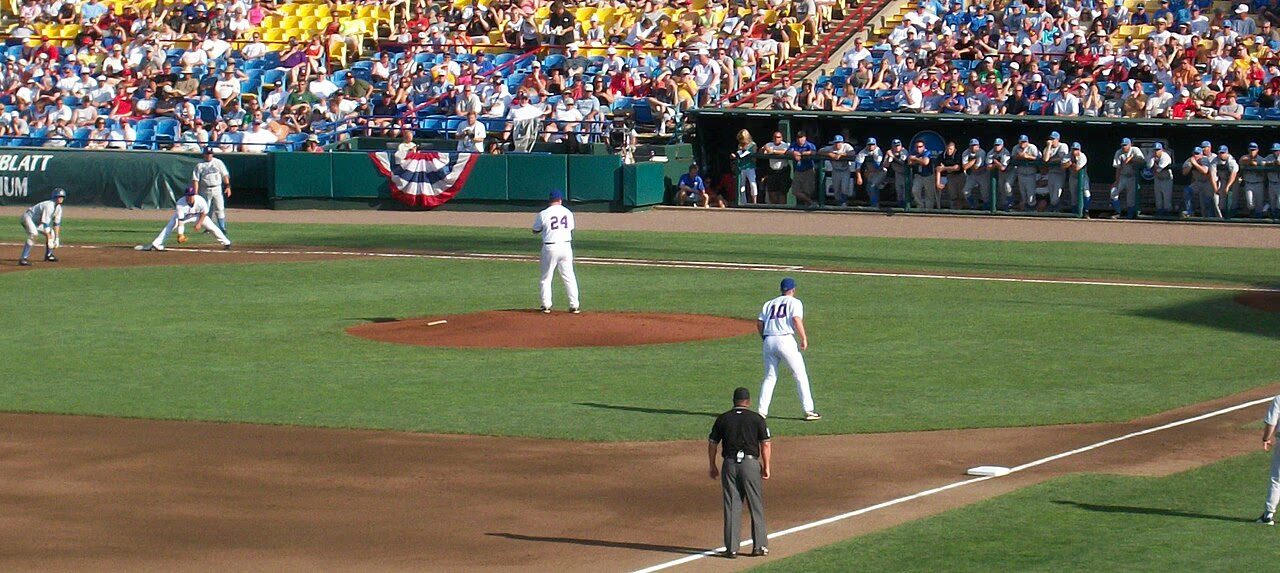
NCAA baseball is the collegiate form of baseball, played by member institutions of the National Collegiate Athletic Association across Divisions I, II, and III. Competition is conducted under the NCAA Baseball Rules of the Game, published as a rules book on a two-year cycle (the current edition b...
Runners may lead off and attempt to steal at any time the ball is live.; Force-play-slide rule: A runner approaching a base on a force play must slide directly into the base or veer away; an illegal slide that interferes with a fielder results in the runner and the batter-runner being declared ou...
BBCOR standard: Non-wood bats must meet the Batted-Ball Coefficient of Restitution (BBCOR) performance standard and carry the "BBCOR Certified .50" mark. Wood bats are also permitted.; Dimensions: The bat may be no more than 2⅝ inches in barrel diameter and 36 inches in length, with a length-to-w...
Batting out of order: An appealable violation; the penalty (an out and adjustment of the batting order) depends on when the appeal is made.; Batter-timer violation: A strike is awarded to the batter.; Interference: A runner, batter, or coach who illegally hinders a fielder making a play is declar...
The NCAA Division I Baseball Championship is a bracketed postseason: 16 four-team double-elimination regionals (a 64-team field), then best-of-three super regionals, leading to the eight-team College World Series in Omaha — itself a double-elimination tournament followed by a best-of-three champi...
Unsportsmanlike conduct — abusive language, throwing equipment, contact with an official, fighting — results in warnings, ejection, and, where applicable, further disciplinary action by the conference or the NCAA.; An ejected individual must leave the playing area; the head coach is responsible f...
The force-play-slide rule and the collision rule at home plate are designed to reduce dangerous contact between runners and fielders, with the malicious-contact penalty (out and ejection) as a deterrent.; The double base at first base separates the paths of the batter-runner and the fielder.; The...
The team with more runs at the end of a regulation (or extra-innings) game wins.; A game ended by the run-ahead rule is complete, and the score stands.; Called and suspended games: When a game is stopped for weather or darkness, the rules define when it is a complete game, when it is suspended fo...
Illegal or altered bat: Use of a bat that is not BBCOR-certified (where required), is altered, or fails bat testing results in penalties that can include calling the batter out, ejection, and removal of the bat.; Failure to wear required protective equipment is corrected by the umpire and can car...
Foul lines: Extend from the back point of home plate through the outside edges of first and third base to the outfield fence; foul poles mark where the lines meet the fence.; Running lane: A marked lane in foul territory along the last portion of the base path to first base, within which the batt...
A regulation game is nine innings. The home team does not bat in the bottom of the ninth if it is already ahead.; Conferences may schedule seven-inning games for doubleheaders under the rules book's provisions.; If the score is tied after the regulation number of innings, the game continues into ...
Don't steal bases or manufacture runs with a commanding lead
When ahead by a large margin—commonly cited as 8 or more runs, or in a game approaching the NCAA run rule (10 runs after 7 innings)—it is considered disrespectful to steal bases, execute hit-and-runs, or bunt for hits. Such actions are seen as running up the score and embarrassing the opponent unnecessarily.
The NCAA's 10-run run rule heightens sensitivity at the college level; continued aggression when a mercy-rule game is imminent is viewed as particularly poor sportsmanship by coaches and opponents alike.
Never bunt to break up a no-hitter
Laying down a bunt solely to end a no-hitter—rather than as a genuine offensive tactic—is one of baseball's most serious taboos. The convention holds that a hit must be earned through a legitimate swing; exploiting the bunt merely to spoil a historic pitching performance is widely condemned across all levels of the sport.
Electronic or technology-assisted sign-stealing is forbidden
While a runner on second base using visual observation to decode and relay catcher signs through physical gestures is traditionally accepted as part of the game, using any electronic device, video feed, or off-field communication system to steal and relay signs is a serious ethical violation condemned across all levels of baseball.
The 2017–18 Houston Astros scandal elevated this from a background understanding to an explicit ethical bright line; NCAA programs have since treated electronic sign-stealing as an honor code and conduct issue, not merely a technical violation.
Never mention a no-hitter in progress to the pitcher or in the dugout
When a pitcher is working on a no-hitter, teammates avoid acknowledging it aloud, sitting next to the pitcher, or breaking any established routine. Drawing attention to the accomplishment is believed to jinx it. Coaches at all levels reinforce this expectation, and violating it draws immediate reproach from the bench.
Pitchers are expected to retaliate when a teammate is hit intentionally
If an opposing pitcher hits your batter in a context perceived as intentional—especially after a home run or during an escalating exchange—the convention holds that the next pitcher must respond in kind by plunking an opposing batter. This 'policing the plate' norm is central to baseball's tradition of self-governance and team protection.
At the NCAA level this frequently results in ejections and multi-game suspensions; coaches invoke it as a matter of team loyalty and culture, though the tradition is under pressure from governing bodies.
Don't admire your home run or flip your bat toward the opposing dugout
After hitting a home run, batters are expected to put their head down and round the bases at a measured pace—not stand to watch the ball, flip the bat ostentatiously, or direct celebrations toward the opposing pitcher or dugout. Such behavior is considered showing up the pitcher and reliably draws retaliation.
Bat-flip culture is a particularly active debate in college baseball, where 'old-school' coaching norms are prevalent; players who showboat are sometimes benched by their own coaches regardless of conference affiliation.
Don't swing 3-0 when your team holds a large lead
With a 3-0 count and a commanding lead, taking the pitch is expected. Swinging away in a lopsided game is considered unnecessary aggression—tantamount to rubbing it in. At the college level, players routinely look to the third-base coach for a take sign in any 3-0 situation when the margin is significant.
Frequently cited in NCAA coaching discussions as part of game-situation sportsmanship; coaches typically enforce this explicitly through signal systems.
Ready to dive deeper?