

🏛️Official — CAWF
Loading OpenSourceSports…
Show immediate concern if you hear your opponent's arm snap
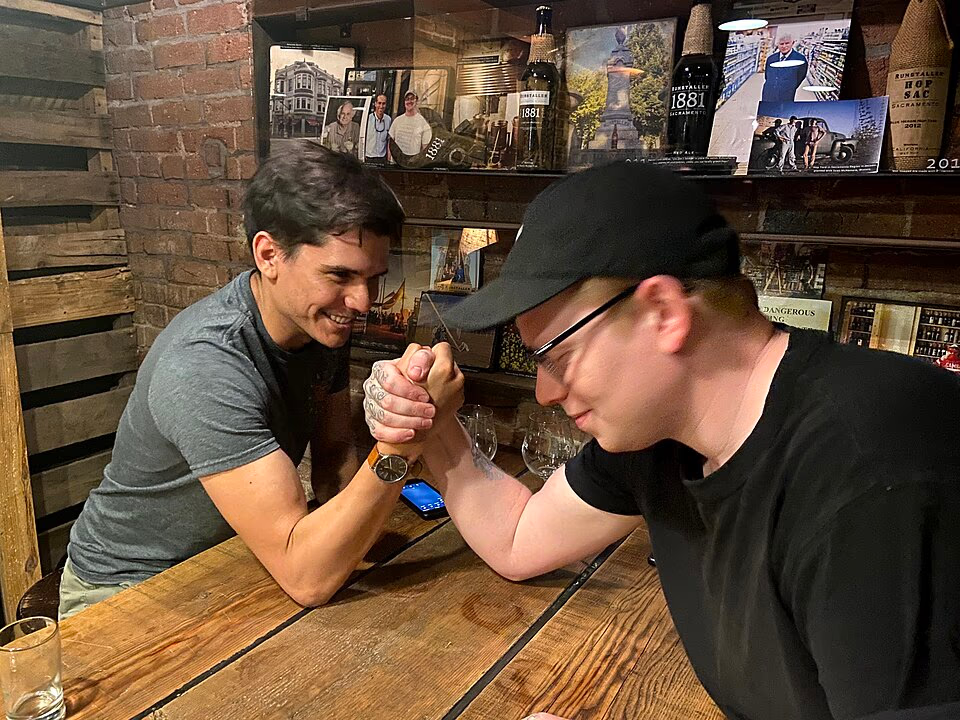
Spiral fractures of the humerus are a known risk in arm wrestling. The cultural expectation is that if a competitor hears or feels the opponent's arm break, they stop immediately and show concern — never celebrate or gloat. Continuing to pull through an obvious fracture is widely condemned.
Acknowledge your opponent before and after every pull
Arm wrestling has a well-documented 'brotherhood' culture. Competitors are expected to greet opponents warmly, make eye contact, and offer a genuine handshake or embrace after the match regardless of outcome. This norm is remarked upon by outsiders as unusually collegial for a combat sport.
CAWF endorses WAF-spec table (104 cm tall × 91-93 cm long; padded elbow pads + pegs + touch pads); Mandated short-sleeve shirt (mid-bicep maximum); no jewelry; trimmed nails; Indoor sport shoes; chalk permitted at championship level
Why people argue about this
People often assume that the short-sleeve shirt requirement is just about comfort, but in reality, it's a crucial part of ensuring fair competition by preventing arm thickness from affecting the outcome. The confusion arises because they overlook how different sleeve lengths can give an unfair advantage or disadvantage based on individual body build and muscle development.
Indoor competition floor with multiple parallel tables (Right-Arm + Left-Arm); Provincial qualifiers + Canadian Nationals + East/West Championships rotate venues; Athlete weigh-in + medical station + judge protest table on-site
Why people argue about this
People often assume that all armwrestling matches are played in one central table setup, forgetting about the different configurations needed for right-arm vs left-arm matches or when rotating venues between provincial qualifiers and national championships. The confusion arises because of the need to accommodate various match types within a single competition structure.
Two competitors per match (1-on-1); Weight classes inherit from WAF (with optional CAWF-specific adjustments for junior development categories); Age categories: Sub-Junior, Junior, Senior, Masters, Grand Masters; Para and Open divisions
Why people argue about this
People often assume that all armwrestling matches must have two competitors from the same weight class, which is why they argue; however, the official ruling allows for optional CAWF adjustments for junior development categories, meaning matches can involve players from different classes if it benefits young or smaller competitors.
Starting position: elbows on pads, non-pulling hand grips peg, foot on floor; referee centers grip; Referee starts match with "Ready... Go!"; Win condition: pin opponent's hand to touch pad
Why people argue about this
People often assume that in championship matches, a win is achieved by simply pinning their opponent's arm to the mat for 30 seconds, which they mistakenly believe happens automatically after three rounds. However, the actual rule requires you to actually pin your opponent’s hand to the mat for one full round (90 seconds) to secure a victory in championship matches.
1 point per round won; best of 3 wins match; Single-elimination bracket with double-loss elimination (repechage); Gold/Silver/Bronze per weight class per arm per age category
Why people argue about this
People often assume that if they win two rounds in a match, they automatically win by default, which leads to arguments when sometimes it's actually the loser who gets one point per round lost. The confusion arises because under CAWF scoring rules, winning just two out of three rounds is enough to declare a winner, not necessarily needing to win all three to claim victory.
Standard WAF foul taxonomy: elbow off pad, shoulder off-line, foot off floor, false start, grip break; Anti-doping: Canadian Centre for Ethics in Sport (CCES) testing program; WADA Code aligned; Unsportsmanlike conduct: disqualification
Why people argue about this
People often assume that unsportsmanlike conduct only results in a warning in armwrestling, forgetting that it can lead directly to disqualification if serious enough. This oversight leads to arguments about whether certain behaviors warrant such severe penalties or just a simple caution.
Same primary injury risk as WAF: spiral humerus fractures, shoulder strain, elbow ligament damage. CAWF mandates competitor education on safe arm posture; referees authorized to halt for breaks in arm position.
Why people argue about this
People often assume that armwrestling injuries are solely due to brute strength, so they misunderstand why education on safe postures is crucial. They think it's just about toughening up, but actually, the rule aims to prevent serious fractures and ligament damage by teaching competitors proper positioning to avoid overextending their arms.